Occupational therapy
What occupational therapy does for children
Edited by Hannah Chamberlain — pending clinician review
Occupational therapy helps kids build the everyday skills they need to play, learn and look after themselves. Here's what an OT does and who it helps.
Edited by Hannah Chamberlain — pending clinician review
Last updated 21 June 2026
General information with cited sources, not clinical advice. See the Hey Sprout editorial policy for how we write, update and correct pages.
"Occupational therapy" is one of those terms that sounds like it's about jobs. For children, it isn't — a child's "occupations" are the everyday things they need and want to do: getting dressed, holding a pencil, joining in at the playground, sitting still enough to learn. An occupational therapist (OT) helps a child build the skills to do those things more easily.[]
What an OT helps with
OTs working with children usually focus on a few areas:[]
- Self-care — feeding, dressing, toileting, and other daily routines.
- Fine motor and coordination — the hand and finger skills behind drawing, cutting, doing up buttons, and handwriting.
- Play and social participation — taking turns, joining games, and managing the give-and-take of being with other kids.
- Sensory processing — how a child takes in and responds to sounds, textures, movement and light, which can affect how settled or overwhelmed they feel.
- Attention and self-regulation — the building blocks for sitting, focusing, and managing big feelings.
The goal isn't to make a child "normal" — it's to remove the friction between them and the things they're trying to do.
Who occupational therapy helps
An OT might work with a child who has a developmental delay, autism, ADHD, a physical disability, coordination difficulties, or sensory sensitivities — or a child who's simply finding one part of daily life harder than expected.[] For children with a developmental delay, getting the right support early can make a real difference to how they manage later on.[]
What happens in OT
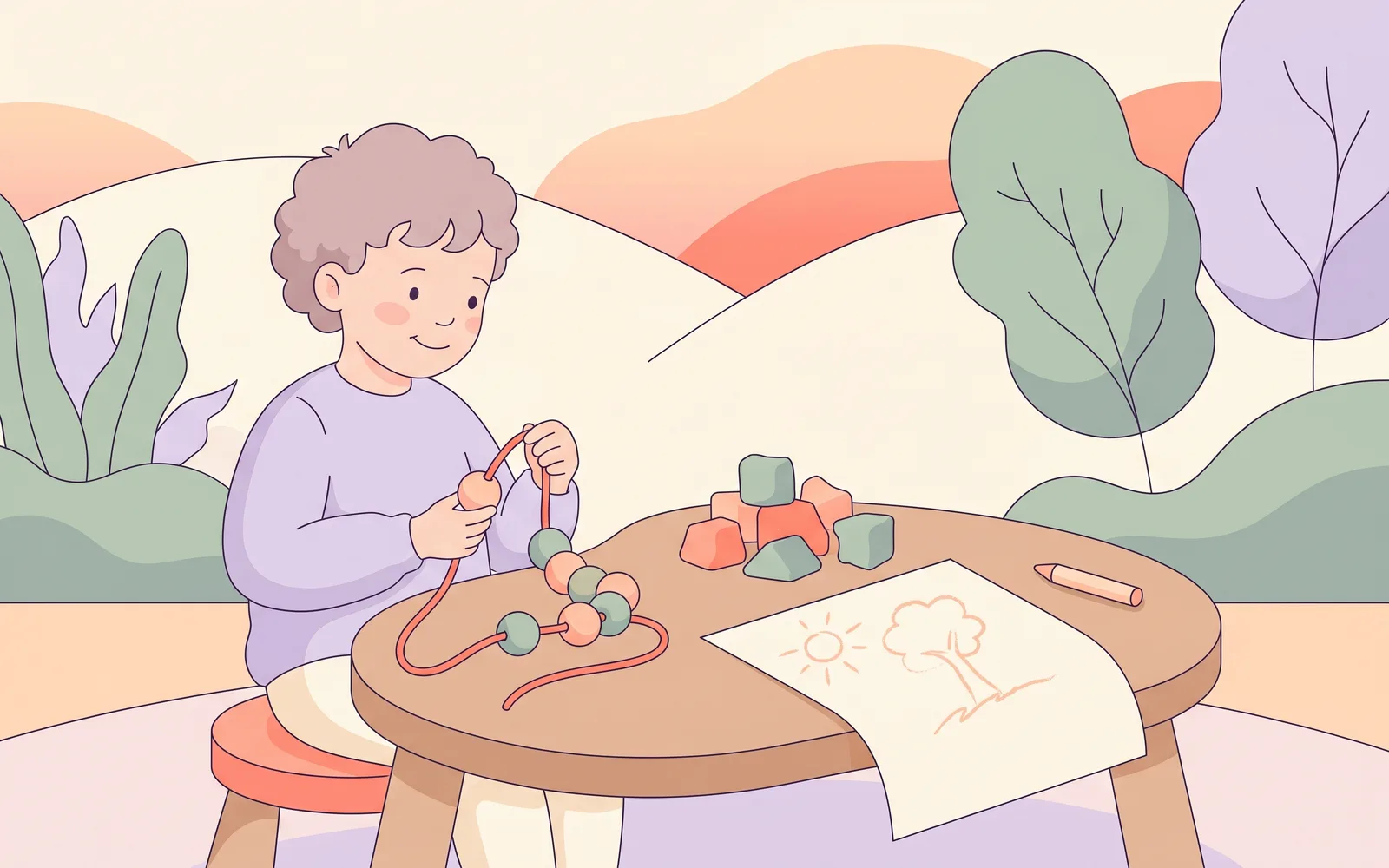
Good occupational therapy rarely looks like "treatment." It looks like play — because play is how children learn. An OT will watch how your child moves and responds, then build activities that quietly stretch the skill that's tricky: an obstacle course for coordination, a craft task for fine motor control, a game that practises waiting and turn-taking.
A big part of the work happens between sessions, with you. OTs coach parents to weave small strategies into ordinary routines, which is where the real progress is made.
Does it work online?
For ideas at home, try these fine motor and gross motor activities.
Yes. Telehealth has become a well-evidenced way to deliver early intervention and therapy for children, with research finding it a viable alternative to in-person care — partly because it brings the work into the child's own home, where their everyday occupations actually happen.[] At Hey Sprout, your OT coaches you through activities in real time, and you'll see goals and home-practice tasks on your dashboard between sessions.
If you're not sure whether OT is the right fit, our intake team can help you think it through — there's no commitment in asking.
Keep reading
What to expect in a first online therapy session
A plain-English walk-through of a first online therapy session at Hey Sprout — setting up, what actually happens, your role as a parent, and what comes next.
Early intervention options while you wait
When it comes to a child's development, starting support earlier tends to mean better, faster progress. Here's the evidence — and how online therapy beats the wait.
How Hey Sprout supports this
References
- Occupational therapist: family guide — Raising Children Network (Australia), 2026
- Developmental delay in children — Raising Children Network (Australia), 2026
- Early Intervention for Children With Developmental Disabilities and Their Families via Telehealth: A Systematic Review — Journal of Medical Internet Research, 2025