Occupational therapy
School readiness checklist for prep, kindy and reception
Written by the Hey Sprout team — pending clinician review
A practical school readiness checklist covering self-care, fine motor, talking, feelings and attention, with the first-year school name for each state.
Written by the Hey Sprout team — pending clinician review
Last updated 4 November 2026
General information with cited sources, not clinical advice. See the Hey Sprout editorial policy for how we write, update and correct pages.
School readiness is about whether your child can manage the day: looking after their own things, getting along with others, coping with big feelings, listening to a teacher and having a go at new tasks. It's much broader than knowing letters and numbers. The checklist below covers self-care, fine motor, communication, social-emotional and attention skills, with notes on when it's worth getting support before your child starts prep, kindy, reception or whatever your state calls the first year of school.
What your state calls the first year of school
The Australian Curriculum calls the first year of school Foundation, but each state and territory uses its own name for it.[] Watch out for "kindy". In New South Wales and the ACT, kindergarten is the first year of school. In Victoria, Queensland, Western Australia and Tasmania, kindergarten is the year before school.[]
| State or territory | Year before school | First year of school | Age of entry to the first year |
|---|---|---|---|
| NSW | Preschool | Kindergarten | 5 by 31 July |
| Victoria | Kindergarten | Prep | 5 by 30 April |
| Queensland | Kindergarten | Prep | 5 by 30 June |
| Western Australia | Kindergarten | Pre-primary | 5 by 30 June |
| South Australia | Preschool | Reception | 5 by 1 May for Term 1, or 5 by 31 October for Term 3 |
| Tasmania | Kindergarten | Prep | 5 by 1 January |
| ACT | Preschool | Kindergarten | 5 by 30 April |
| Northern Territory | Preschool | Transition | 5 by 30 June |
Source: Australian Bureau of Statistics.[] Check the current rules with your state or territory education department, as they can change.
Readiness is broad, not academic
Researchers at the Royal Children's Hospital Melbourne describe the older idea of readiness, a child reaching a certain age or skill level, as too limited. Readiness also depends on families, early childhood services, communities and schools being ready to support each child.[] In other words, a school that adapts to your child counts as much as your child adapting to school.
When teachers complete the national Australian Early Development Census in the first year of school, they look at five areas: physical health and wellbeing, social competence, emotional maturity, language and thinking skills, and communication and general knowledge.[] Literacy is one part of one area. In the first year, children learn through experimenting, practising and playing, and reading and writing are taught there.[]
No child ticks every box. Use the list to spot what to practise over the coming months and anything worth checking with a professional.
Self-care
By about 5, most children can:[][][]
- Go to the toilet on their own, including wiping and washing hands
- Dress and undress themselves, including shoes. Buckles or velcro they can do up alone make life easier while laces are still being learnt
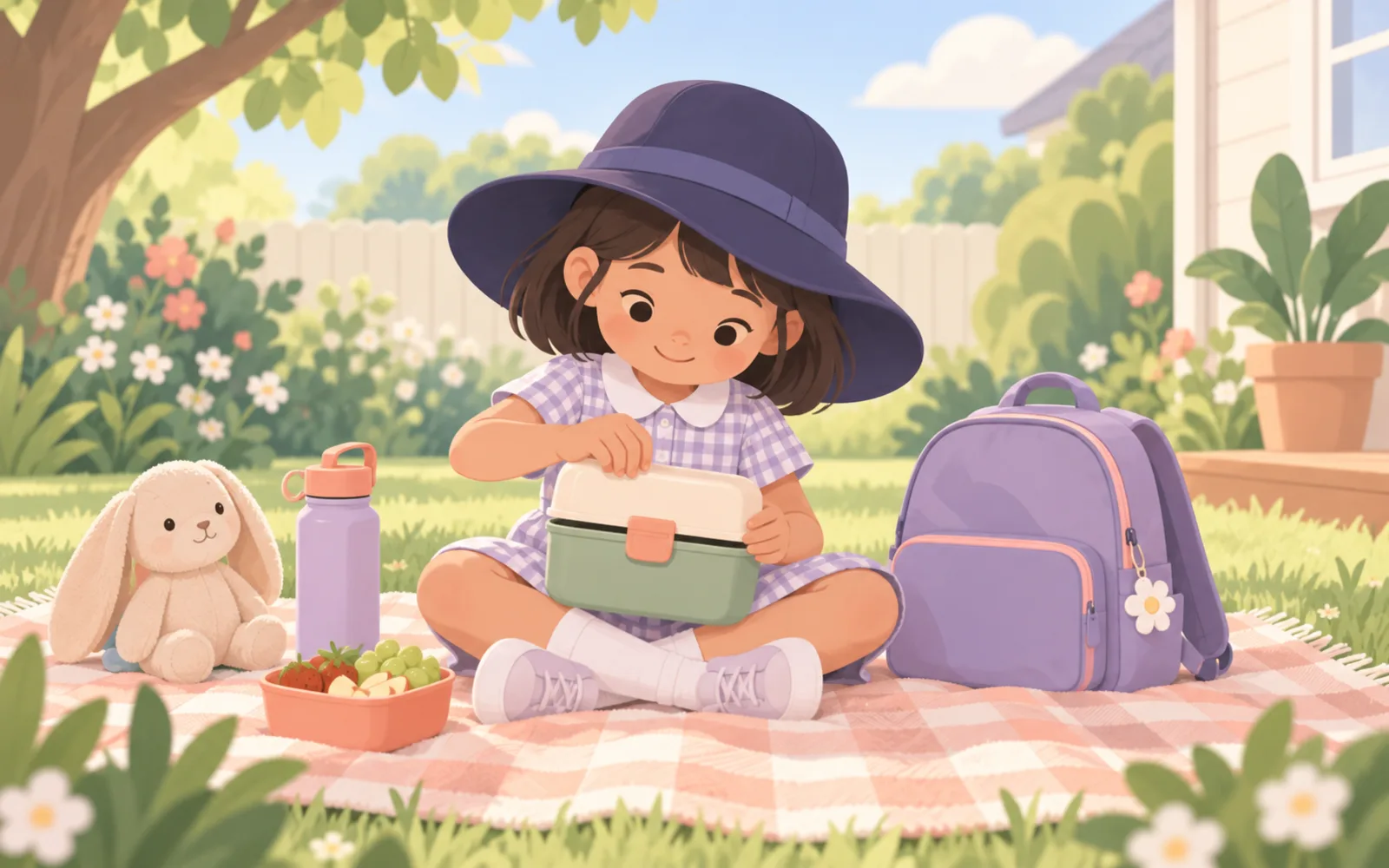
- Open their own lunchbox, food packets and drink bottle
- Use a spoon and fork, and sometimes a knife
- Keep track of their bag, hat and jumper
- Ask an adult for help when they need it
Practise with the actual uniform, shoes, lunchbox and drink bottle before day one. A picnic lunch at home is an easy rehearsal.[]
Fine motor and physical skills
NSW Health occupational therapists suggest it helps if a child starting school can:[]
- Hold a pencil with some control, using the same hand each time
- Draw a picture you can recognise, such as a person with a head, body, arms and legs[]
- Cut along a line or around a simple shape
- Have a go at writing their name
- Sit at a table with enough strength and posture to work for a short time
- Run, climb and throw a ball in the playground
Physical readiness also includes having the energy for a full school day. That makes sleep part of the checklist. Try to settle a regular bedtime and wake-up time, even on weekends, in the weeks before school.[][]
Communication
By around 5 years, most children:[][]
- Speak clearly enough that you can understand them all the time
- Use full sentences and can tell you about their day
- Follow instructions with several steps, like "put your bag away, wash your hands and sit on the mat"
- Ask questions and say how they feel
- Enjoy stories, rhymes and jokes
Our speech and language milestones for 5-year-olds go into more detail on what's typical, including early sound and rhyme skills that help with reading.
Social and emotional skills
At 4 to 6 years, children are learning to:[][]
- Play with other children, take turns and share, even if favourite toys are still hard
- Follow simple rules in games and group routines
- Say sorry and try to get along
- Name feelings, with help for big ones like frustration or jealousy
- Manage their feelings better than a year ago, with fewer tantrums
- Separate from you at drop-off without long-lasting distress
Some worry about starting school is normal at this age.[] For support with big feelings, see our page on emotional regulation.
Attention and learning
By 5 to 6 years, children usually:[][]
- Pay attention to an activity for longer than they used to
- Follow simple class-style routines, like packing up or sitting for a story
- Know their full name and age
- Show interest in books, letters and numbers, without needing to read yet
When to seek support
The checklist is a guide. Raising Children Network suggests seeing your GP or child and family health nurse if your 5-year-old:[]
- Has trouble seeing or hearing things
- Can't understand instructions with several steps, or has trouble having a conversation
- Doesn't play with other children, or acts in a very aggressive way
- Seems afraid, unhappy or sad a lot of the time
- Is easily distracted and can't concentrate on any single activity for more than a few minutes
- Is clumsy, finds it hard to use a pencil or crayon, or has trouble drawing shapes like circles or squares
- Has difficulty eating, dressing or using the toilet
- Has lost skills they once had
Depending on the concern, your GP might suggest a speech pathologist for talking and understanding, an occupational therapist for self-care and fine motor skills, or a psychologist for worries, big feelings or attention. If anxiety is part of the picture, our guide to childhood anxiety and when to get help may help.
If your child has a disability, ADHD or other additional needs, talk to the school as early as possible. Enrolling early gives the school time to plan supports, and a transition plan written with teachers and therapists can make the first weeks smoother. Occupational therapy can also help build independence with shoes, clothing, lunchboxes and school bags.[]
Next steps
Two skills worth a closer look are pencil grip and fine motor skills.
Pick the two or three items your child is furthest from and practise them through everyday routines over the next few months. Share anything you're unsure about with your child's early childhood educator, who sees them in a group setting every week. And if you'd like to talk it through, you can send Hey Sprout an enquiry.
Frequently asked questions
Does my child need to read or write before starting school?
No. Reading and writing are taught in the first year of school. It helps if your child is interested in books and has a go at writing their name, but schools don't expect children to arrive reading. Raising Children Network suggests not expecting too much academic progress too soon.
Should I hold my child back a year if they are young for their year?
It depends on your child and your state's rules, which differ. Talk with your child's early childhood educator and the school, and with your GP or a therapist if you have developmental concerns. Remember that readiness also depends on how ready the school is to support your child.
When should I tell the school my child has extra needs?
As early as you can. For most government schools you can enrol at any time in the year before your child starts, and enrolling early gives the school time to plan supports and apply for any funding. Catholic and independent schools have their own timelines.
My child gets very tired and grumpy after school. Is that normal?
Yes, very common in the first weeks and months. School is a big step up in social demands and rules. Keep afternoons quiet, offer a snack straight after pick-up, hold off on extra activities for a while, and aim for an early bedtime.
Keep reading
Picky eating or a feeding problem? How to tell the difference
Most picky eating is a normal stage. The red flags that suggest a feeding difficulty, mealtime strategies that help, and who to see if you're worried.
Pencil grip by age: stages, activities and when it matters
How pencil grip develops from fist to tripod, approximate ages for each stage, activities that help, and what research says about whether grip style matters.
Sensory seeking behaviour in kids: signs and what helps
What sensory seeking looks like, why some kids crave more movement and touch, safe ways to meet the need at home and school, and when to see an OT.
How Hey Sprout supports this
References
- Preschool Education methodology, 2024 — Australian Bureau of Statistics, 2025
- About the AEDC domains — Australian Early Development Census, Australian Government, 2024
- Policy Brief 10: Rethinking school readiness — Centre for Community Child Health, Royal Children's Hospital Melbourne, 2008
- Child development at 4-5 years — Raising Children Network (Australia), 2026
- Child development from 5-6 years — Raising Children Network (Australia), 2026
- Preparing Little Hands for School: a Kindergarten orientation package — South Western Sydney Local Health District, NSW Health, 2014
- Primary school: preparing children — Raising Children Network (Australia), 2026
- Enrolling & starting school for kids with disability or ADHD — Raising Children Network (Australia), 2026
- The Australian Curriculum: information for parents and carers, Foundation — Australian Curriculum, Assessment and Reporting Authority (ACARA), 2023