Speech
Help your child talk — language activities
Edited by Hannah Chamberlain — pending clinician review
You don't need flashcards or special equipment to grow your child's language. The best speech-building activities are the ordinary moments of your day.
Edited by Hannah Chamberlain — pending clinician review
Last updated 21 June 2026
General information with cited sources, not clinical advice. See the Hey Sprout editorial policy for how we write, update and correct pages.
If your child is a late talker, it's tempting to reach for flashcards or an app. But the most powerful thing for building language isn't a product — it's you, talking and playing alongside them through the ordinary moments of the day.[] Here are simple, evidence-aligned ways to do more of it.
Narrate the day
Talk about what you're doing as you do it: "I'm pouring the milk… now we stir." This "self-talk" and "parallel talk" floods your child with words tied to real things in front of them, which is exactly how language sticks.[][]
Follow their lead
Watch what your child is looking at or reaching for, and put words to it. If they point at a dog, you say "Dog! A big brown dog." Responding to their interests — rather than directing the play — gives them a reason to communicate and keeps them engaged.[]
Play with words
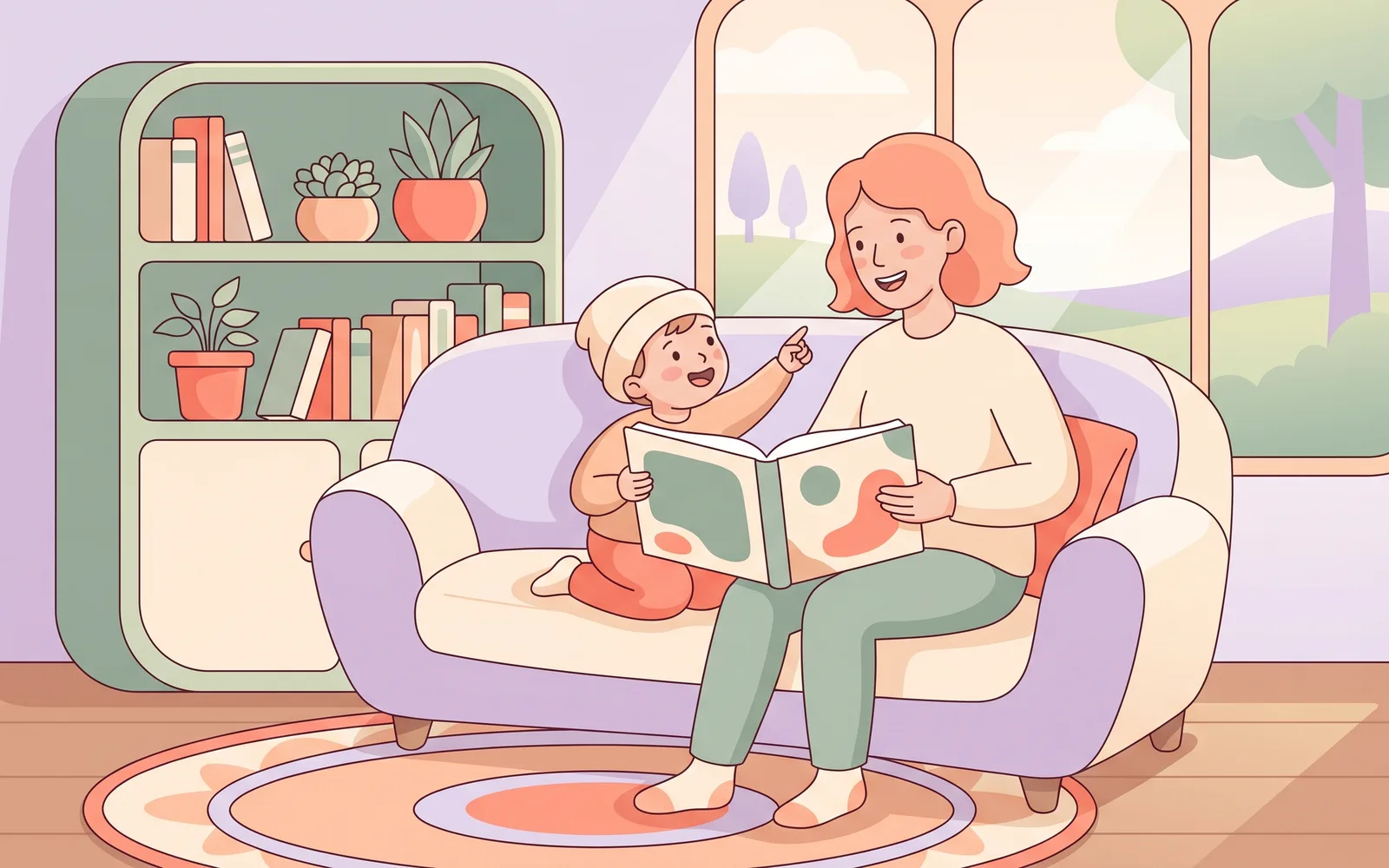
Everyday play is a language goldmine. Singing, naming games ("Where's Teddy's nose?"), reading the same book over and over, and silly turn-taking games all give your child repeated chances to hear and try words.[] Repetition isn't boring to a toddler — it's how they practise.
Expand, don't correct
When your child says "more juice," resist the urge to correct. Instead, gently expand: "You want more juice — yes, more apple juice please." This shows them the next step up without making talking feel like a test.[]
Give them time
Build in pauses. After you ask something or comment, wait — count to five in your head. Children often need a beat to find their words, and rushing in fills the silence they were about to use.[]
When to get extra help
These strategies help every child, but they're not a substitute for an assessment if you're worried. If by age 2 your child isn't putting two words together, or by age 3 strangers struggle to understand most of what they say, it's worth talking to a speech pathologist. Early support tends to be quicker and easier than waiting to "see if they grow out of it."
To see which sounds to expect when, check speech sounds by age.
A speech pathologist can also tailor these everyday strategies to your child specifically — and at Hey Sprout, that coaching happens in your home over video, so the practice fits straight into your real routine.
Keep reading
What to expect in a first online therapy session
A plain-English walk-through of a first online therapy session at Hey Sprout — setting up, what actually happens, your role as a parent, and what comes next.
Early intervention options while you wait
When it comes to a child's development, starting support earlier tends to mean better, faster progress. Here's the evidence — and how online therapy beats the wait.
How Hey Sprout supports this
References
- Toddlers talking and communication: what to expect and how to help — Raising Children Network (Australia), 2026
- Play ideas for toddler language and talking — Raising Children Network (Australia), 2026
- Activities to Encourage Speech and Language Development — American Speech-Language-Hearing Association, 2026