Getting started
What to expect in a first online therapy session
Edited by Hannah Chamberlain — pending clinician review
A plain-English walk-through of a first online therapy session at Hey Sprout — setting up, what actually happens, your role as a parent, and what comes next.
Edited by Hannah Chamberlain — pending clinician review
Last updated 21 June 2026
General information with cited sources, not clinical advice. See the Hey Sprout editorial policy for how we write, update and correct pages.
Booking your child's first session is a big step — and if you've never done therapy over a screen before, it's normal to wonder whether it really works, and what you're supposed to do. The short version: online therapy is well-studied, your therapist does the heavy lifting, and your job is mostly to be nearby and follow their lead.
Does online therapy actually work for kids?
It's a fair question. The research is reassuring: a systematic review of telehealth-delivered speech and language intervention for primary school-age children found that children made improvements similar to those seen with in-person sessions.[] A broader 2025 review of telehealth early intervention reached the same conclusion — that it's a viable alternative to in-person care for young children with developmental needs and their families.[]
What makes it work isn't the screen — it's the therapist's plan and your involvement. Online sessions lean on a coaching model, where the clinician guides you to practise strategies with your child in your own home, the place they're most comfortable.[]
Before the session
You don't need special equipment — a laptop, tablet, or phone with a camera and a stable internet connection is enough. A few minutes beforehand:
- Pick a quiet-ish spot where your child can see the screen and you can sit alongside them.
- Have a couple of favourite toys or a snack nearby — the therapist may ask you to use them.
- Test the link from your dashboard so you're not troubleshooting at the start time.
If your child wanders off-camera in the first few minutes, that's completely fine. Therapists who work with children expect it and plan around it.
What actually happens
The first session is mostly about getting to know your child and what you're hoping to work on. Your therapist will usually:
- Chat with you about your child's history, strengths, and what's prompting the referral.
- Play and interact with your child to see how they communicate, move, or respond.
- Talk through early goals and what the next few sessions might look like.
It feels more like a guided play session than a clinical exam — which is exactly the point.
Your role as a parent
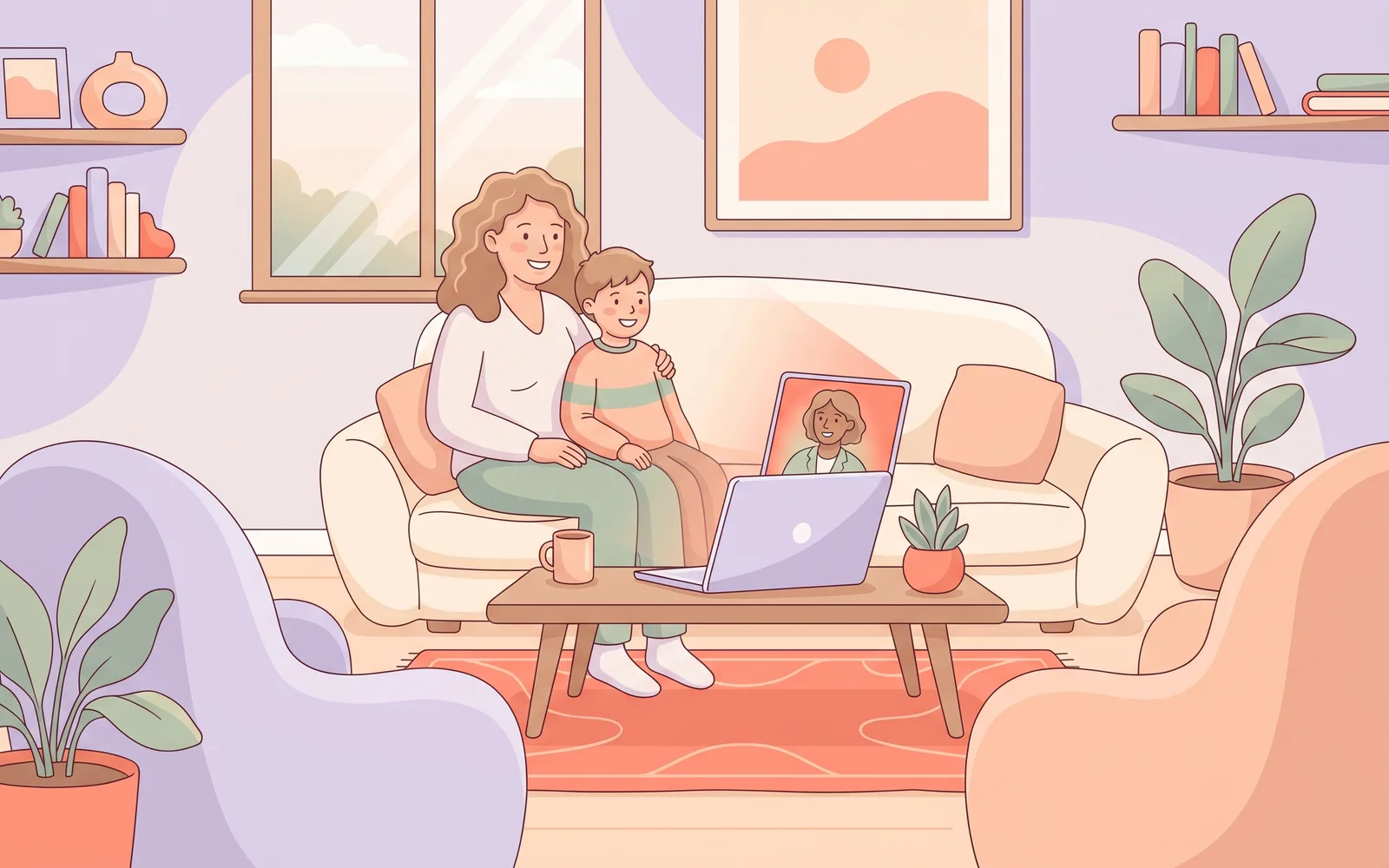
This is the part that surprises people. In online sessions you're not a bystander; you're often the therapist's hands. They might ask you to hold up an object, model a sound, or gently prompt your child while they coach you in real time. That hands-on involvement is one of the reasons telehealth works so well for young children — the skills get practised in your everyday routine, not just in a clinic room.[]
After the session
You'll usually finish with a clear sense of what's next: a short summary, a goal or two, and often a small "home practice" activity to try before the next session. At Hey Sprout you'll see your therapist's notes, your goals, and any home practice on your dashboard, so nothing depends on remembering it all in the moment.
A quick word on NDIS funding
For the evidence behind online sessions, see what the research says about online therapy for kids.
If your child has an NDIS plan, therapy is typically funded under Capacity Building supports — and for children under 9, the early-childhood pathway is designed to get support in place early.[] You can use Hey Sprout on a self-managed or plan-managed plan. Agency-managed? Ask the NDIA or your LAC about plan management.
Whenever you're ready, booking takes a few minutes and you'll pick a time that suits your family.
Keep reading
Early intervention options while you wait
When it comes to a child's development, starting support earlier tends to mean better, faster progress. Here's the evidence — and how online therapy beats the wait.
Childhood anxiety — when to get help
Some worry is a healthy part of growing up. Here's how to tell ordinary fears from anxiety that's getting in your child's way — and when to seek support.
Help your child talk — language activities
You don't need flashcards or special equipment to grow your child's language. The best speech-building activities are the ordinary moments of your day.
How Hey Sprout supports this
References
- The Efficacy of Telehealth-Delivered Speech and Language Intervention for Primary School-Age Children: A Systematic Review — International Journal of Telerehabilitation, 2017
- Early Intervention for Children With Developmental Disabilities and Their Families via Telehealth: A Systematic Review — Journal of Medical Internet Research, 2025
- Guide to the early childhood approach — National Disability Insurance Agency, 2026